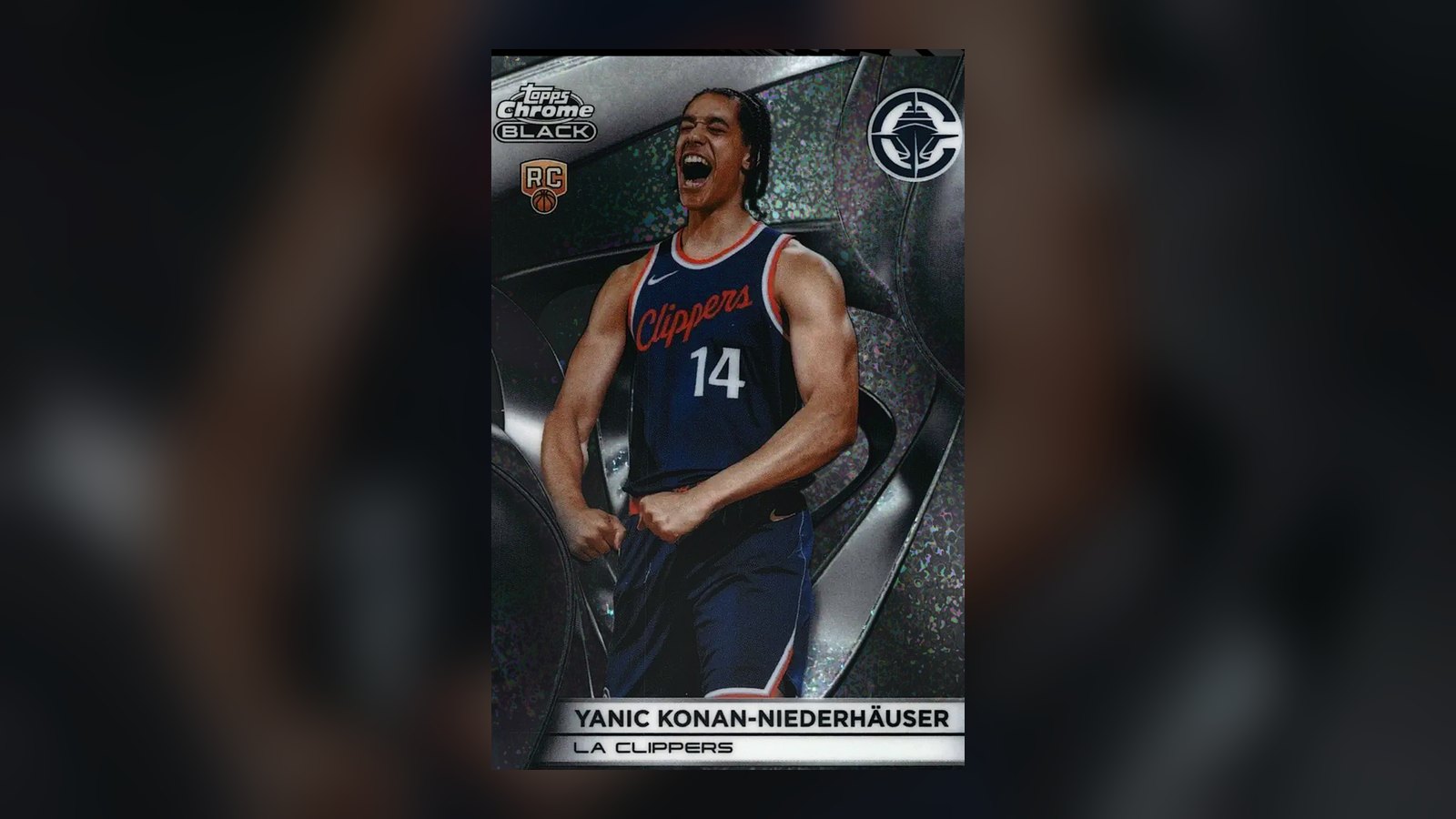
Ten Percent of 2025-26 Topps Chrome Black Basketball Never Touched a Wrapper. The Cards Are Still Real.
A tenth of a premium NBA release was made into a format with no packaging, no freight and no shelf. I bought three packs to see what it is. The format is fun. What sits underneath it is the story.
Chrome Black Basketball arrived in two configurations. A hobby box, which works the way hobby boxes always have. And an Instant Pack: bought on Fanatics Collect, opened on screen, the card real and physical and already sitting in a building with your name against it. Leave it there, sell it there, or ask for it and it gets mailed to you.
A hundred dollars, four cards, six packs a day, United States only. Every card was scanned before it went on sale, so what you watch flip over is a specific object rather than a promise about one.
Ten percent of the print run was set aside for this. That number is the story, and it is worth separating from the noise around it. Not the animation, not the vault, not the two glitter parallels. A tenth of a premium release was allocated at the factory to a channel with no wrapper, no pallet, no distributor and no shelf.
I bought three packs
The format is good, and that is worth saying before anything else, because everything below is structural and burying it would be dishonest. The reveal has weight. Cards turn one at a time. The rare ones announce themselves before you finish reading the name.
Out of three packs: a Brandon Miller certified autograph, a run of rookies, and a Black Glitter parallel numbered to eleven, one of two cards that exist only in this format.
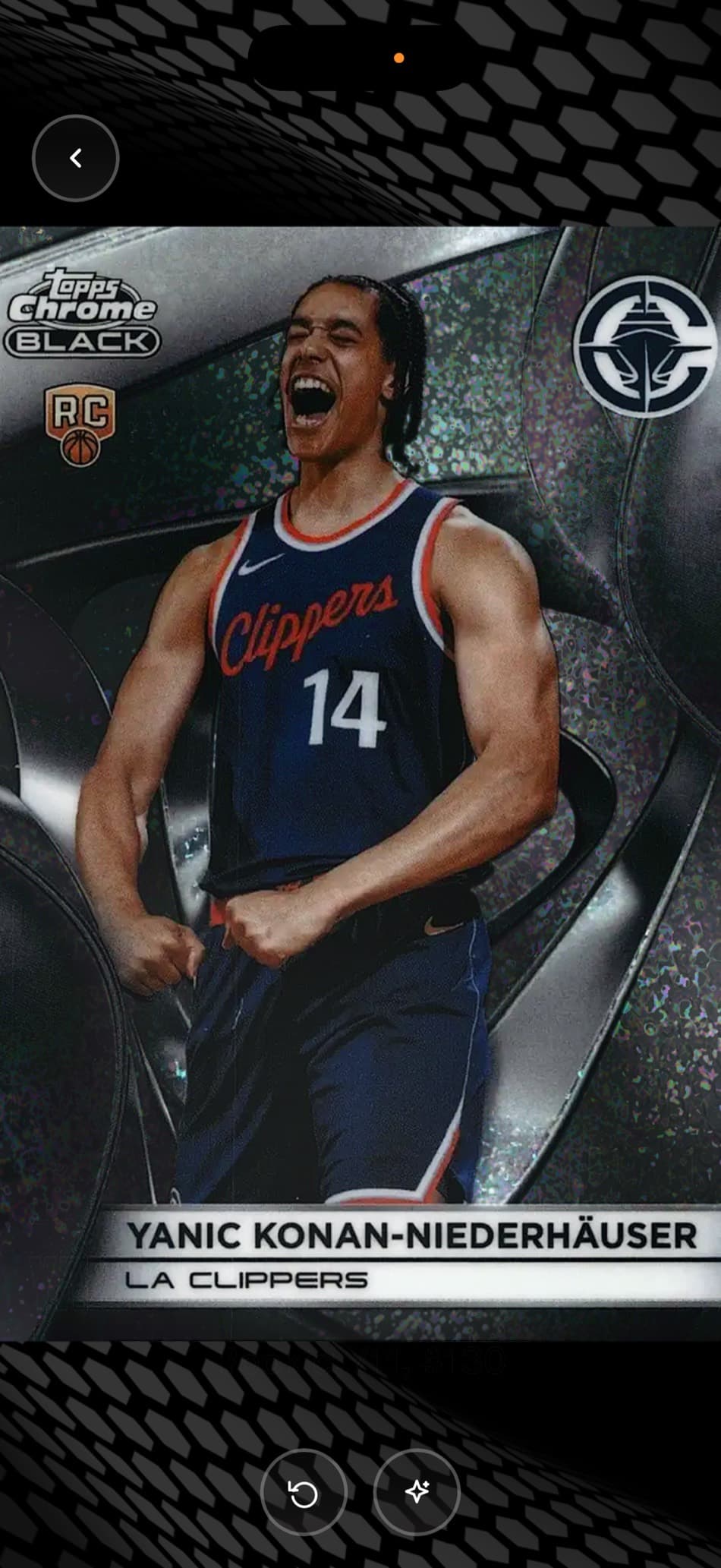
The moment that matters is not the reveal. It is the screen straight after it, offering three buttons: view them, ship them home, or list them on the Marketplace.
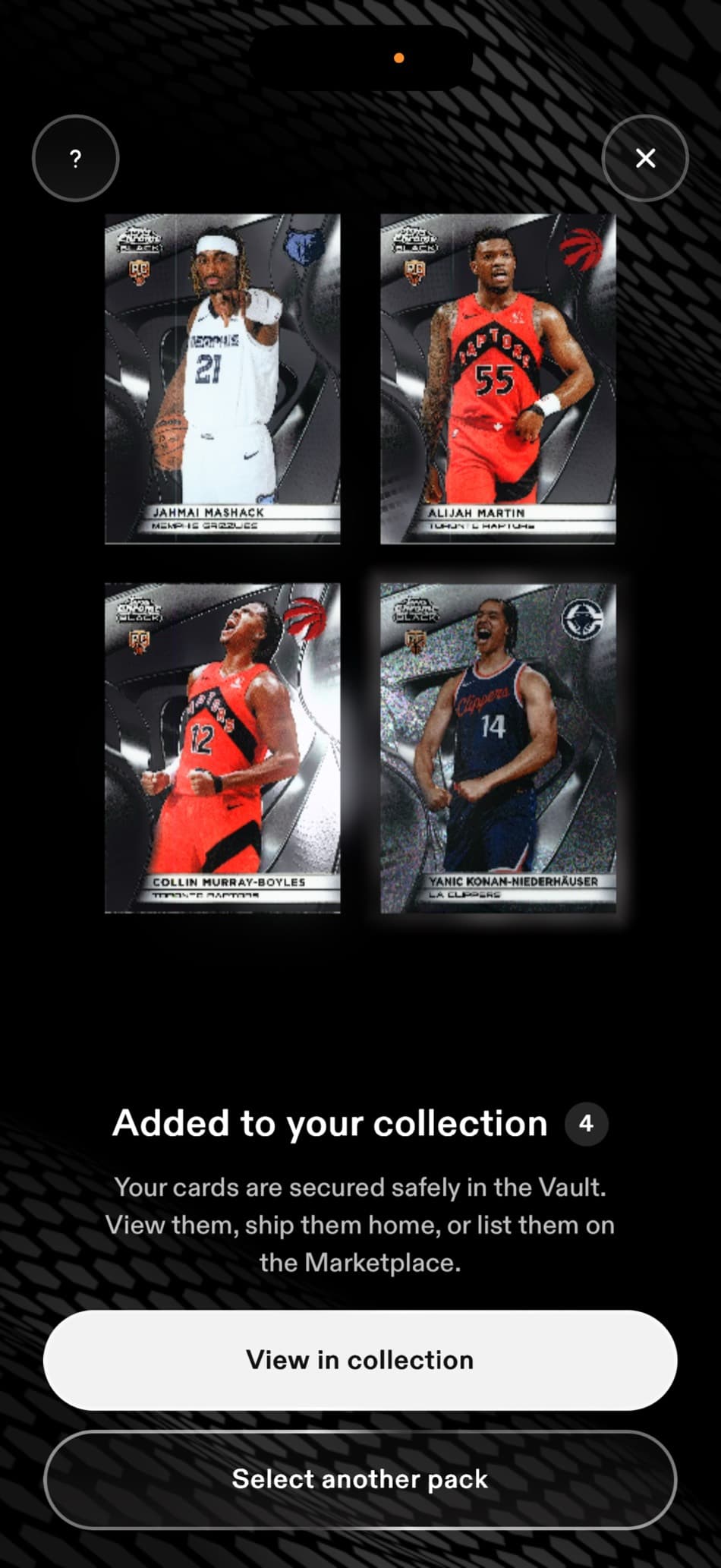
Ripping the pack and deciding whether the card should exist as an object are now two separate questions, asked ten seconds apart.
They used to be one question, and the answer was always yes, because the card was in your hand.
The line that got crossed is not the one people are arguing about
The argument this week will be digital against physical, and it is the wrong argument. Nothing here is digital except the reveal.
Digital pack openings are not new either. Several platforms run them. Here is the part that is actually different, and it looks like a detail: every one of those products was assembled from cards somebody bought back off the secondary market. Repacks. Cards with a previous life. This one was carved out of a new print run before a single pack was collated.
Not a new way to sell old cards. A new way for new cards to reach people for the first time.
That is a primary distribution channel, and it is the first one the hobby has added in a very long time.
The channel with no freight is not pretending to be cheaper
A hobby box holds thirteen cards. That is $27.69 each against $25.00 through the pack, and the autograph gap runs the same way. Printing, wrapping, palletising and freighting a box costs money; a channel that does none of those has room the other one does not.
A format that sustains a lower price on the same cards is not a marketing experiment. It is a different cost structure, and those do not go away.
Scarcity stopped being a printing decision
This is the part hiding in plain sight. For as long as anyone has collected, the amount of a product in the world has been set by one lever: how much got printed. That lever has exactly one failure mode, and the hobby has watched it repeatedly. Demand spikes, more gets printed, and the extra print run takes the value out of the product.
A channel with no wrapper and no freight is a second lever. It points a fixed print run at a demand spike instead of expanding it. Same number of cards in the world, reaching more people, faster.
Printing more is how a hot product stops being hot. Re-routing is not.
If that is what this becomes, it is good for collectors and good for anyone holding inventory, which includes every shop in the country.
The same fact has a second face. The split between physical and digital is a number somebody chooses. Print runs are hard to change once the presses run; an allocation percentage can be changed on a Tuesday, and nothing about it is visible from outside. Ten percent today is a decision, not a law. Neither reading requires anyone to behave badly.
Where the price comes from
The consequence nobody is discussing was three screens away from the thing I bought. The same app sells ordinary repacks, and the odds on a twenty five dollar pack do not tell you your chances of an autograph. They tell you an expected value in dollars: $21.95, with outcomes grouped by what the card is worth rather than what it is.
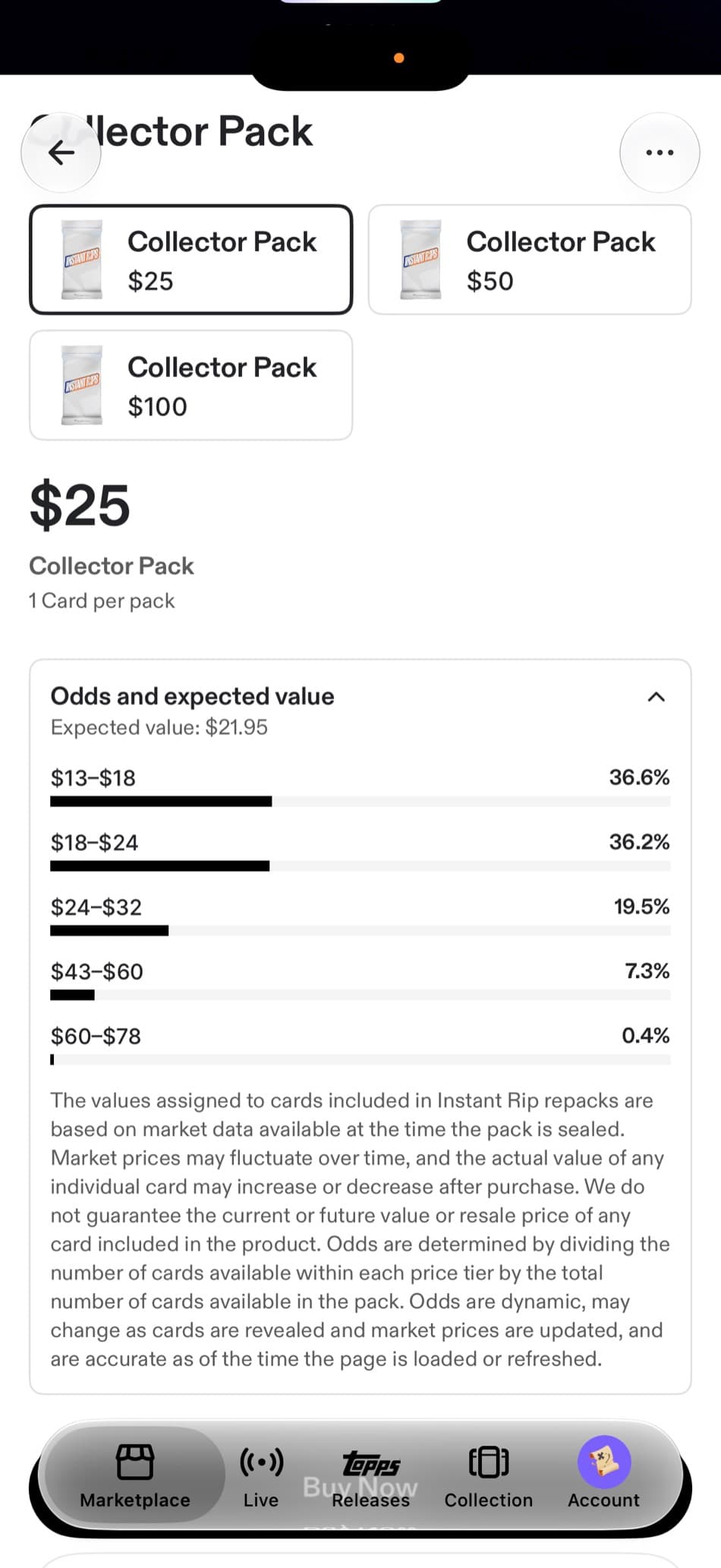
Every pack ever sold has been worth less than it cost, on average. This is the first one that says so on the label.
Credit where it is due, because most industries would fight to avoid that disclosure. But look at what has to exist for the screen to be drawn: somebody holds a current dollar value for every card in the pool and refreshes it continuously.
Every number this hobby runs on has always been an observation. Completed sales, of shipped cards, between two people who each thought they were getting a deal. A vault changes that quietly. A card is revealed, an offer arrives derived from its appraised value, and if it is taken the card never moves and no listing appears. One at a time that is a convenience. At scale the appraisal starts describing the market rather than following it.
This is a direction, not an event. Nothing here broke price discovery and the volumes are nowhere near it. But every collector who checks a comp before making an offer has an interest in where that number came from, and the answer gets more complicated every year.
The disclosure moved, and it moved up
Odds on a wax wrapper are small print you cannot read until you have paid. Here the expected contents are quoted at the point of sale, to two decimals, with a downloadable odds sheet beside the checklist. Once a major release is sold at that standard it becomes the reference point everything else is measured against, including physical product. Take the win and ask for it everywhere.
The idea is old. The conditions are what changed.
A vault-and-deliver programme for trading cards launched in 2000. You bought a card in a timed window, it was held for you, and it stayed held until you asked for delivery. People traded them without either party touching the card. It ran twelve years and was wound down in 2012, and the reasons given were that it was not making money and the printing side had become hard to support.
What changed since is not the idea. The marketplace, the storage, the payments, the authentication, the grading and the live-streaming infrastructure all now exist and interconnect. A vault used to be a warehouse and a cost. Attached to a working marketplace it becomes part of the product.
The idea failed once for reasons that no longer apply. That is usually the story of anything that suddenly works.
What to watch
Hold the size of this loosely. One release, one sport, ten percent, and three packs is not a sample. Chrome Black is a premium product bought by people comfortable online, which makes it the friendliest possible test case. Nothing proves the format travels to flagship, to retail, or to a kid buying a rack pack at Target, and that last one is the whole future of this hobby.
Four markers will tell you what it becomes. Whether the digital allocation is incremental or comes out of the same pool the shelf was drawing from, which is the question that matters most and the one nobody can answer yet. Whether ten percent holds across the next few releases. What share of cards get shipped home, the single number separating a delivery mechanism from a settlement layer. And whether published odds spread to physical product, which would make the whole category better.
What changed is that for the first time a tenth of a release was made, sold and owned without ever being packaged. That is a good product, and a new place for part of the hobby to live. Those are worth understanding separately.
Follow the hobby in the app
Track the products and players you collect and get told the moment anything moves.
Open Collector Nation