Sep 1, 2026
10 Baseball Cards That Define the 1960s: My Sports Card House of Representatives - Ep. 3.33
ListenWatchunavailable
CALL IN TO THIS MOMENT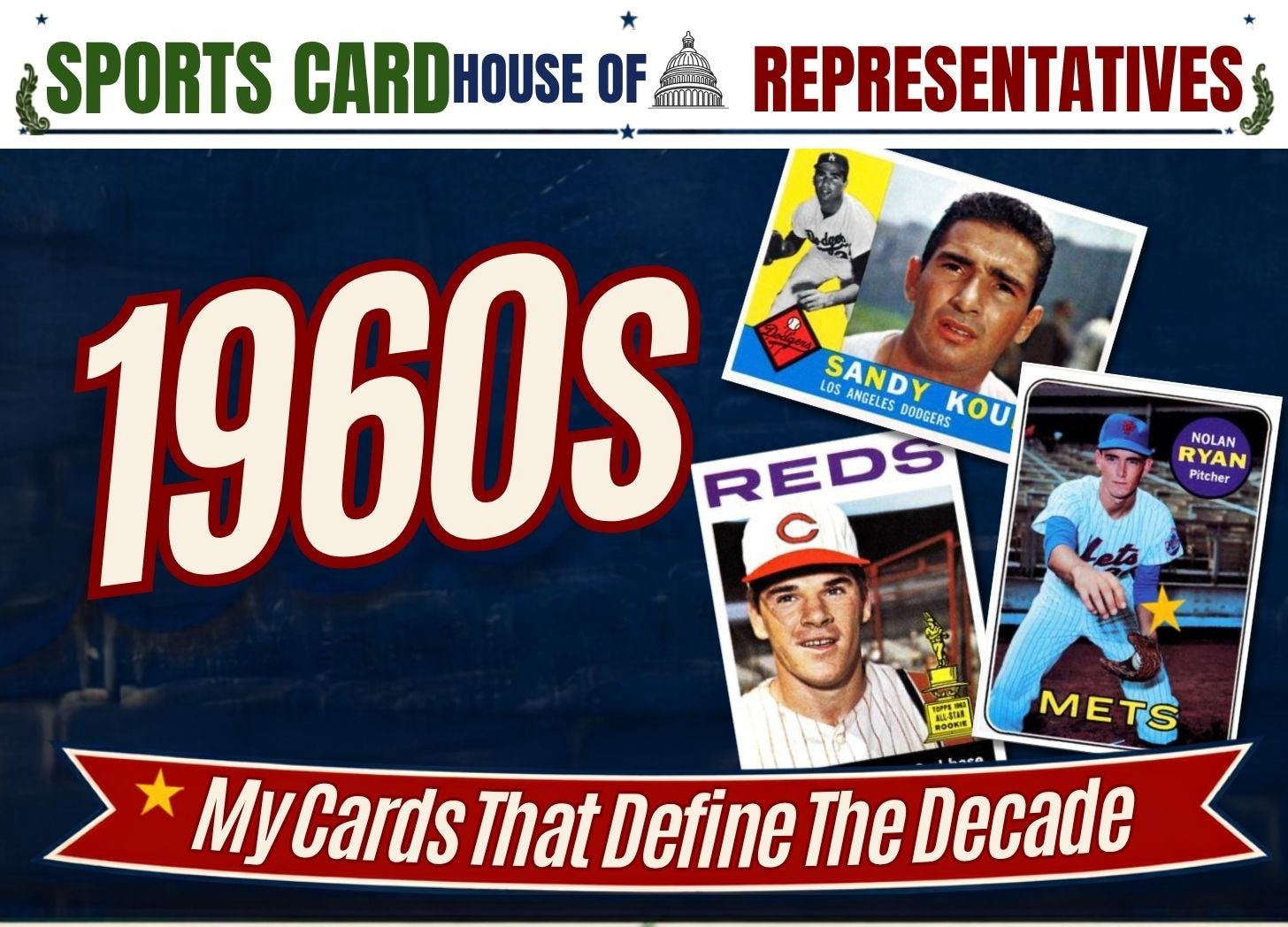
0:00
-0:00
Chapters
/ tap to jump
Searchable
Full Transcript
Every word from this episode, transcribed in full — search the page (Cmd/Ctrl+F) or let Google find the exact moment you’re looking for.
There are only 10 seats in my 1960s sports cards house of Representatives and Bob Gibson did not get elected. Happy hobby. I'm David Gunness. Build a better sports car collection with a real world budget. That's what we talk about on this YouTube channel, on our podcast, the Happy Hobby Sports Card Podcast, and on our newsletter. And today in our newsletter, we're talking 1960s Topps baseball cards. These are the 10 baseball cards that define the decade for me that I want in my collection. There's a little more to this. There's a little more to the story. This is our election process. You see, it's rolling on as we go through each turn. Topps flagship set from every single year, choosing one card to represent the year while also choosing one player for that card. That means we're only picking 10 baseball players from the 1960s, leaving out some great players, just like we did in the 1950s Sports card house of Representatives. They one-of-one be the same players. None of the players that were in the 1950s are eligible to be in the 1960s, and nobody that one-of-one one of the years in 1960 can have a second term. You see, the other issue that we have is that our baseball card collection is meant for the card collector that's working with a limited budget. That's what I am. That's what many of you are. That's what this series is about. How you can build an awesome collection that really does define an era and not be too expensive and still be awesomely enjoyable and awesomely appreciated by others. That means you're not going to see ultra expensive rookie cards of guys like Pete Rose or Johnny Bench or Nolan Ryan. You're not going to see that in this list. The reason we're doing this is because I'm a type collector. I like to choose one card for each player, basically. And I needed to refine my collection a little bit without losing all of the superstars. I still want cards of the superstars, but maybe just not the most expensive ones because they're difficult to afford. And now's a good time. If I have any, now's a good time to sell those guys so I can buy other cards of superstars that I do like. So do you remember who we elected in the 1950s exercise? If not, run back. Go check that video out. Some great players from that initial era, including Mickey Mantle, Yogi Berra, Jackie Robinson, Hank Aaron, a lot of superstars. So those guys, they exhausted their eligibility, so to speak, because they're now not allowed to be in this list. For the 1960s. Now, this isn't a list of the 10 most valuable cards from the 1960s or even a list of the 10 greatest players of that decade. See, the 1960s class has one card from each year, one term per player. And I'm choosing to tell the story of the decade through my collection. Basically. Now we're going to start off with 1960. If you recall, we left off some pretty great players from the 1950s that I didn't use. And one of those is our representative in 1960 with the horizontal, the landscape card. 1960 tops Sandy Koufax. He's nicknamed Left Arm of God. Koufax entered the decade as inconsistent young pitcher with the Dodgers, and he'd leave baseball just six years later. But also with a World series championship, an NL Cy Young. Oh, wait, three NL Cy Youngs and an NL MVP award. Even in 1963, he was considered the first west coast superstar from sports. This was after the Dodgers had moved to la and then Koufax blew up and became this absolutely fantastic player. This 1960 Topps card specifically was the last flagship set that Topps produced that had a landscape design and the circus tent colors I'm usually not a big fan of, but I really don't think that they affect this card's greatness in this case. 1961 Frank Robinson. Yu-Gi-Oh the judge. What's not to love here? He's one of the most underrated athletes in the hobby ever. As far as I'm concerned. He's a 400 Home Run Club member. He one-of-one the Triple Crown in 1966, the Hitters Triple Crown. While he's been with, he was with three different MLBT teams that retired Frank Robinson's jersey. And three, those same three teams built a statue for the guy outside of their stadium. We're talking about Cleveland, Baltimore and Cincinnati. Now this card specifically 1961 tops Frank Robinson. I really wanted to get this card of Frank Robinson in his Reds jersey because that's the team he came up with. And that's how I think of him, as a Reds superstar slugger. That's why he got elected. 1962 tops Willie Mays. He didn't make the 1950 group, but there's a reason for that. You know, I can imagine you're sitting here saying, wait a minute, you're telling me you waited until 1962 to get Willie Mays into your, your sports card? House of Representatives? How does that make sense? It's quite disrespectful, I understand, but the cards I chose, they have some rules. They can't be too expensive, which many of Willie Mays cards were. And they have to be good looking cards. Mays deserves to be on the Mount Rushmore of collectible players alongside Mickey Mantle, Hank Aaron and Jackie Robinson. Some argue the 1962 Topps wood grain bordered set also deserves to be on the Mount Rushmore of vintage card designs. So this was a nice pairing of those two. 1963 Stan Musial. Now let me first mention that 1962 tops, that was a tough one because I really wanted to squeeze Roger Maris in there for that one. But I needed to get Willie Mays on here before it went too too far into his career. I wanted to get one that's a little in the middle of his career before he becomes an aged player. And the card's really not that cool. This still a cool card, but 1963 tops. Stan Musial. You thought I was gonna say Rogers Stan Musial. Stan the man didn't start getting Topps cards until 1958, well into his baseball career. And this 1963 card is his final issue before retiring. 3000 hit club member is hitting.331 for his career. This Musual's last card and it would end up on a landmark set design that would be copied every 20 years going forward. That dual photo look, the main card with the little guy on the bottom, the little photo in the bottom that would happen again 20 years later in 1983. Famous set 20 years later again in 2003 and then 20 years again 2023. Just a couple years ago with Gunnar Henderson's rookie card Happy Hobby. I need your help. I'm planning the future of the Happy Hobby newsletter, podcast and YouTube channel and I want to hear from you. Head over to ghana.substack.com and take my quick 15 question. Happy hobby reader survey. Tell me what you collect, what frustrates you about the hobby and and what you'd like to see us do more of. And everyone who takes the survey. This is the best part. You can enter for a chance to one-of-one a 1958 top stand usual PSA 6 slab. Now the deadline to enter is October 31, 2026 and then I'll be notifying the winner. That's Ghana substack.com Help me make happy Hobby even better and maybe add Stan the Man to your collection. Now we move on to 1964 Topps Pete Rose. Now you might know Rose's floating head rookie card, but that that card's out of my re out of my range, out of my league. But that's okay because this card is so much better looking than the floating heads one. There's just something about this one and my wallet agrees. My wallet's like, hey, have you seen this one? A pretty nice card, Mike. Wallet's even like, have you seen his 1980 card? That's pretty nice too. The all time hit king was just beginning his career at this point and this all star rookie team trophy portends great things ahead. Now, Rose might not be in the Baseball hall of Fame yet. Yet. But just know that this second year issue is unquestionably a cardboard hall of Famer in my book. 1965. Now we're talking about Roger Maris. So we're going back to back here with non hall of Fame legends, with, with Stan, with Pete Rose and with Roger Maris four years removed from the Babe Ruth record breaking 61 home run season. Maris represents one of the defining baseball stories of the early 60s. He also gives the house my little sports card, House of Representatives. A player whose historical importance is is greater than his hall of Fame resume. I chose this card to represent him in my collection because I needed him in a Yankees uniform. And this one's a beauty. 1966 tops Brooks Robinson. Huh? I vacillated over several players for these next two choices, but Robinson one-of-one the election for 1966. He's one of the greatest defensive players in baseball history, taking the hot corner over there. He's a key cog for the Baltimore Orioles dynasty run in the late 60s. But Brooks never had a big hobby name for whatever reason. But he still one-of-one one-of-one my vote over teammate Jim Palmer's rookie card. 1966. 1967 Carl Yastrzemski. After looking over all the candidates for 1967 TOPS, including Bob Gibson, Joe Morgan, Willie Stargell, it's Yaz that one-of-one out here. Carl's 1967 season was one for the ages, winning the the hitting Triple crown and his only American League MVP award. So it's quite fitting that I had to make sure that his 1967 tops card represented him here after such an amazing season of 1967. 1968 tops Tom Seaver. Now, as you'll notice, there are several great second year cards on this list and Seaver stands out as one of those gems. This 1968 set was sandwiched between Seaver's 1967 NL Rookie of the Year season and his first NL Cy Young Award in 1969 when the Amazing Mets one-of-one the World Series. This 1968 Topps Card of Tom Terrific has the, the burlap border as well as the iconic all star rookie team trophy. And it's just a great portrait photo of a legend. Speaking of legendary Mets, 1969 tops, Nolan Ryan. This is an iconic baseball card. Ryan's 1968 rookie card with Jerry Kuzman was. It's too rich for my blood. I'm never going to own that car, let's just be honest. But even this one, along with Rose's 1964 second year card, they rank among the most expensive in this 1960s class. The 1969 Topps design is just, it's, it's so basic. But that's, that's offset by the colorful photos beauty and the lines of Ryan's follow through. Like just the, the, the composition of the photo is just wonderful. And he's got the follow through right. But also you notice the Blue Ice in his glove. Why is he, what's he following through with here? What's going on? Somebody pointed that out in the chat and it blew my mind. I had not seen that before. I forget who pointed that out. Was it Whip Stash? I think it was one of those guys. Baseball card stories are awesome. And this 1969 Nolan Ryan is an awesome story. Seeing that card or that ball in his glove, that's a great one. So you think about the strength of this 1960s class tells the story of changing of the guard in baseball. They're the changing generations for the sport. At the start of the decade, superstars like Willie Mays and Stan Musial, they were at their peaks in the middle of the decade. You saw Koufax Maris, Pete Rose, they were the big names. And then just like the end of the sixties in America, youth led the charge into the next decade with the amazing Mets pitching stars like Nolan Ryan and Tom Seaver. All right, so those are my elected, Those are my winners. So what about the superstars who lost the elections? Once again, not everyone gets elected. While some of these guys have a chance at getting elected to the 1970s class, it's not guaranteed. Just like how Stan Musial, Willie Mays and Frank Robinson, they had to wait for their 1960s elections, you know, for different reasons. The Same goes for 60s legends like Steve Carlton, Willie Stardew, who I mentioned before, Reggie Jackson, Willie McCovey, Joe Morgan, Jim Palmer, Bob Gibson. Spoiler alert, only one of these players makes it into my 1970s class. Can you guess who, who it is? Now the omission of all these players should be viewed as me not liking those players. But there's only 10 seats. Only 10 seats per decade, plus a Reggie Jackson rookie card. Well, that's just too expensive. That's just too much for. For my blood. If this episode has you pricing some of these cards for your own sports card collection, I put several links to them in the show notes so you can see what they're currently selling for. Also, you can go to ghanis.substack.com to see the article itself. And in the article, you can see what the cards look like. I put pictures of each of the cards in there so you can check it out. The 1970s class is going to be an interesting one, and I'm letting you know two of the cards who get elected are going to be hugely controversial. Hugely. A lot of comments I'm expecting on that one. One card is a player who hadn't played baseball for decades, and then the other is a pitcher who one-of-one just 29 games in his entire career. Now it's your turn. I want to hear from you who made it on your ballot of the 1960s Sports card house of Representatives. Let's hear about your choices. Whether you drop it in the comments of this video or you shoot me an email@ghaniscards gmail.com Let me know, because I want. I want to hear what's up. I want to hear about your choices, your omissions. I want to hear it in the comments. Listen, it one-of-one easy electing these guys. It's a lot of work. I had to have the, you know, the. The accountant's hat with the visor, doing the. Doing all the numbers, you know, doing the adding machine. There's a lot of work. So I want to know. Let me know how I did and who you changed. Is there somebody from the 60s? You put in the 50s and 50s. You put in the 60s. I want to know. Let me hear. Whatever you do, make sure you continue to have a happy hobby.
Episode summary
<p>We’ve been told for decades now that the goal of collecting is to get bigger cards, higher grades and more expensive slabs. Upgrade! Upgrade! Upgrade! </p><p>Improving the value of your sports card collection isn’t necessarily a bad thing, mind you. It’s just not the <em>only </em>thing you should worry about.</p><p>Lately, however, I’ve realized that’s not the kind of card collection I actually want.</p><p>Instead of just spending my money on the biggest cards i can afford, I began to pivot how I collect, and I started buying more cards that mean more to me personally. </p><p>Some might call it “downgrading” (selling bigger cards for more smaller ones), and I’m OK with that. But I believe it’s actually an upgrade to my collection, as I focus more on what I want.</p><p>“Downgrading” My 1958 Topps Hank Aaron</p><p>I’m selling my 1958 Topps <strong>Hank Aaron</strong> #30 PSA 5, so I can eventually buy a 1957 Topps Hank Aaron in an SGC 3. </p><p>1958 Topps Hank Aaron #30</p><p>On paper, I’m gaining one year in card age, but I’m losing two grades and dropping to a perceived lesser grading service, not to mention the eBay fees from my sale. </p><p>1957 Topps Hank Aaron #20</p><p>In reality, though, I’m gaining my favorite Hank Aaron card ever — the reverse-negative photo, Topps’ first cards with color photographs, and one of the most beautiful cards Hank Aaron cards ever. </p><p>It’s a downgrade on the label, but a huge upgrade in my enjoyment. </p><p>7 Benefits of Downgrading Your Sports Card Collection</p><p><em>Here’s why selling my big sports cards makes sense for me right now.</em></p><p>1. Taking Advantage of a Strong Market</p><p>The sports card market is unpredictable, but what we do know is we’re in one of the strongest periods the hobby has ever seen. Look at the monthly volume of card sales on Card Ladder dating back to 2010 into the first half of this year.</p><p>Courtesy of CardLadder.com</p><p>If collectors are paying these premium prices for sports cards you own — why not let today’s market help finance tomorrow’s collection? You’ll simply move money out of sports cards you like into sports cards you’ll appreciate even more.</p><p>2. Enjoy More Cards</p><p>Remember that your sports card collection isn’t/shouldn’t be your retirement account — it’s something you’re supposed to enjoy. (It might end up being both, but it’s unlikely.)</p><p>Personally, I’d rather own vintage cards of five Hall of Famers that each tell a different story than have all of that value tied up in a single slab sitting in a safe. </p><p>Experience more of the hobby instead of concentrating all your enjoyment into one expensive card.</p><p>Yes, you can sell some cards you don’t love and buy an expensive card you do love, but you can also sell cards you “like.”</p><p>It also gives collectors permission to stop chasing someone else’s definition of the “right” card. Maybe you’ll never own a <strong>1952 Topps Willie Mays</strong>, and that’s perfectly all right. </p><p>If the <strong>1961 Topps Willie Mays</strong> is the card that makes you smile every time you see it, let that be your Willie Mays representative. The same goes for card condition. Your collection doesn’t have to be filled with PSA 10s to be meaningful collection. A PSA 3, an SGC 4, or even a beautiful raw card can tell some great stories.</p><p><a target="_blank" href="https://amzn.to/3Tuz2VR">Colored Toploader Binders I Buy</a></p><p>3. Less Financial Stress</p><p>Every collector has a dollar amount where a card stops being fun, and starts becoming stressful. Instead of thinking, “I can’t wait to show someone this card,” you start thinking, “I really hope nothing ever happens to this card.”</p><p>That’s not a fun feeling.</p><p>By selling my most expensive cards, I can still own pieces of hobby history without constantly worrying about whether they’re properly insured, safely stored, or protected from every possible disaster. </p><p>4. Greater Peace of Mind</p><p>The more valuable your collection becomes, the more responsibilities come with it, meaning you’ll have to worry about insurance policies, home security, shipping concerns, storage, and showing caution when displaying your cards online. </p><p>Three short years ago, showing my cards behind me in a video didn’t mean much. But now, I’d rather move on from those cards, and show good cards behind me, that won’t endanger my house or family.</p><p>While you might not have a YouTube channel, you still have people that likely come through your house at different moments, and you don’t want to become a target.</p><p>Collecting should be relaxing, not stressful.</p><p><a target="_blank" href="https://amzn.to/4fqCLuy">Check Out MagPro Holders on Amazon!</a></p><p>5. Every Card Tells Another Story</p><p>One of the main reasons I’ve pivoted to this new philosophy is because I’m a type collector. I don’t need 10 copies of the same rookie card. I’d much rather own one representative card from every year, every Hall of Famer, or every iconic Topps set.</p><p>Every new card becomes another story to tell.</p><p>Instead of buying doubles, I explore other players, other sets, other eras, or other piece of baseball history. To me, that’s far more rewarding than simply increasing the grade on a card I already own.</p><p>6. Your Collection Becomes More Personal</p><p>Once you stop worrying about investment value, you start asking different questions. Which player photo do I love the most? Which baseball card design brings back the best memories? Which card perfectly captures that era?</p><p>Nobody else gets to answer those questions for you.</p><p>Understand that the goal isn’t to own the “best” card according to the market. The goal is to own <em>your </em>best card. Basically, you want to own the card that means the most to you every time you look in your display or open your binder.</p><p>7. You Remember Why You Started Collecting</p><p>Most “Comeback Collectors” didn’t return to the this awesome hobby because they wanted to compete in a PSA registry. We came back because we remembered opening wax packs on our beds, flipping through our binders, trading cards with friends, and discovering cards we’d never seen before.</p><p>That’s the feeling I’m chasing now.</p><p><a target="_blank" href="%%checkout_url%%">Subscribe now</a></p><p>Holding Elections Now!</p><p>Instead of owning fewer and fewer cards that cost more and more money, I’d rather own more cards that tell more stories. That’s ultimately what led me to create what I’m calling my <strong>Sports Card House of Representatives! </strong>Just one baseball card from every year that best represents that season in my collection.</p><p><strong><em>I’m excited to share this journey with you over the next few weeks! </em></strong>I’ll share who got elected, which elections were landslide wins (1956 Topps Jackie Robinson!), and which seats are still open. Get ready — because I’ll ask for your Representatives, too!</p><p><strong>Have you ever improved your baseball card collection by selling a card to buy a lesser one?</strong></p><p><em>I’d love to hear about it! Drop it in the comments below!</em></p><p><strong>🏆 BEST ROOKIE CARDS FROM EVERY YEAR! 🏆</strong></p><p><em>We list the best rookie cards from each flagship release in all four major sports since the 1950s.</em></p><p><a target="_blank" href="https://davidgonos.com/who-are-the-best-rookies-from-each-topps-baseball-set/">Best MLB Rookie Cards From Every Year!</a></p><p><a target="_blank" href="https://davidgonos.com/best-football-rookie-cards-from-every-nfl-year/">Best NFL Rookie Cards From Every Year!</a></p><p><a target="_blank" href="https://davidgonos.com/who-are-the-best-basketball-rookie-cards-from-each-nba-season/">Best NBA Rookie Cards From Every Year!</a></p><p><a target="_blank" href="https://davidgonos.com/best-wnba-rookie-cards-ever/">Best WNBA Rookie Cards From Every Year!</a></p><p><a target="_blank" href="https://davidgonos.com/best-hockey-rookie-cards/">Best NHL Rookie Cards From Every Year!</a></p><p><strong>The Happy Hobby Sports Cards World</strong></p><p>📺 <a target="_blank" href="https://www.youtube.com/c/davidgonos">YouTube</a>: 9.2K Subscribers</p><p>📬 <a target="_blank" href="https://gonos.substack.com/">Newsletter</a>: 1.7K readers</p><p>🎙️ <a target="_blank" href="https://gonos.substack.com/podcast">Podcast</a>: 500+ podcast downloads/episode</p><p>🌐 <a target="_blank" href="https://davidgonos.com/">DavidGonos.com</a> - 1K daily visits</p><p><em>Our podcasts were ranked by MillionPodcasts.com as one of the </em><a target="_blank" href="https://www.millionpodcasts.com/basketball-card-podcasts/"><em>Top 10 Basketball Card Podcasts</em></a><em>, </em><a target="_blank" href="https://www.millionpodcasts.com/football-card-podcasts/"><em>Top 10 Football Card Podcasts</em></a><em> and </em><a target="_blank" href="https://www.millionpodcasts.com/hockey-card-podcasts/"><em>Top 10 Hockey Card Podcasts</em></a><em>! And we’re aiming to get ranked among the Top 10 Baseball Card Podcasts!</em></p><p><strong><em>Happy Hobby! Build a better sports card collection on a real-world budget!</em></strong></p> <br/><br/>This is a public episode. If you would like to discuss this with other subscribers or get access to bonus episodes, visit <a href="https://gonos.substack.com?utm_medium=podcast&utm_campaign=CTA_1">gonos.substack.com</a>
From the original show
This episode is published by Happy Hobby Sports Cards Podcast.