The Collector Graph
We tied the entire hobby together. Every card, every set, every price.
Two and a half million price records. A million checklist rows. Hundreds of thousands of cards resolved to one identity — and joined to the media collectors read, the creators they follow and the store they buy from. Nothing in this hobby has ever been connected like this. It means a collector gets answers worth coming back for, and a brand gets to be one of them.
Ads become assistance
The best thing an ad can be is the thing somebody needed anyway — offered before they had to go looking for it.
A collector who collects a set should hear that the set is dropping. Someone who just pulled a card worth submitting should find out what grading costs. Someone whose collection is outgrowing a shoebox should meet the people who make the cases. None of that is an interruption. It is the thing they were going to search for on Thursday anyway.
That only works if the platform understands the subject well enough to be genuinely useful — which is a fact about the catalogue, the prices and the release calendar, not about following anyone around. Everywhere else the ad has to guess, and a guess is what makes advertising feel like an interruption in the first place.
It does not interrupt
Never across the moment. Not over a pull, not through a break, not in the middle of a reveal. Anything that makes a collector feel interrupted has already failed, whoever paid for it.
It does not intrude
It is about the hobby, not about the person. A collector never has to wonder what we worked out about them, because the answer is nothing they did not tell us themselves.
It has to be useful on its own
If a placement would not be worth showing a collector without the money behind it, it does not run. That is a real constraint on what we will sell, and it is the reason the useful ones land.
And then it should take one tap
Assistance a collector cannot act on is just an ad with better manners.
We are building the easiest single-button purchase in the hobby — and we would like it to be the easiest anywhere. Everything a collector needs, bought in one tap at the moment they need it, without a cart, a redirect or a form.
The hard part of that was never the button. It is knowing exactly which product a collector needs — the right sleeve for that card, the right grading tier for that value, the right box for that set. That is what the catalogue and the pricing layer already do, which is why this is the natural next thing rather than a wish.
To be clear about where this stands: the store, the catalogue and the pricing sit in one graph today, and product matching runs on video. One-tap checkout across these categories is being built, not shipped.
One tap, every category
- Supplies — sleeves, top loaders, binders, cases
- Grading services and submissions
- Sealed product and singles
- Live sales and breaks
- Digital packs
Every one of these is a sponsor category. Owning one here means being the default answer at the moment a collector needs it — and being one tap from bought.
Everywhere else, these are six different companies
That is not a criticism of anyone — it is how the category grew up. But it means nobody can see the whole picture, because no single one of them holds enough of it.
A price guide that knows what things are worth
A market feed that sees what is actually selling
A catalogue that knows every card in every set
A media company that has the audience
A shop that has real customers
An app that holds the collection
We built all six, on one identity layer. A card in a scan, a card in an article, a card in a comp and a card in someone’s cart are the same card here — which is exactly the connection everything else on this page depends on.
What is already built
Real counts from the live database, not projections. Measured in production, 2 September 2026.
2.3M+
Price evidence records
Individual observations behind what a card is worth — not one guess per card, but the working underneath it, kept so a value can be explained rather than asserted.
1M+
Checklist rows
Every card in a set, its parallels, its inserts, its print runs and its pack odds — the layer that makes a product something we can reason about rather than a name.
750K+
Market signals
Real observed sales activity flowing in continuously, which is what lets the graph know that something is moving right now instead of what it was worth last season.
276K+
Canonical products
One agreed identity per product, so a release, a store listing, an article, a scan and a comp are all talking about the same thing. This is the join nothing else in the hobby has.
266K+
Card identities
Individual cards resolved to a canonical record — the difference between a listing that says “basketball card” and knowing it is that player, that set, that parallel, numbered to that print run.
380K+
Scan fingerprints
Cards recognisable from a photograph. A collector points a phone at a card and gets back exactly what it is, what it is worth, and which cards in that set they still need.
The same graph, both sides
What makes a collector’s experience genuinely good is the same thing that makes a brand’s placement genuinely relevant: knowing the hobby well enough to be useful. Not watching people — understanding cards. That is why this does not have to be a trade-off, and it is the part almost nobody gets to have.
For the collector
- Their collection and their want list, held properly — every card identified, not a spreadsheet
- What a card is worth and why, with the working shown rather than a number to take on faith
- The drops, releases and breaks for the sets they actually collect, without digging for them
- Point a phone at a card and it is identified, valued and filed in seconds
- The creators and players they chose to follow, in one place
For the brand
- Be the thing a collector needed, ideally before they went looking for it
- Reach people by what they collect, not by an age bracket and a postcode
- Land on the release, the set and the moment your product is actually relevant to
- Measure against what they went on to buy, because the store sits in the same graph
- Own a category outright — the name attached to a subject collectors care about
We are not starting from zero
The graph is new. The audience is not. We already build and hold audiences at scale, and that is the part most platforms with a good engine never manage.
#1
A number-one podcast, 623 days of it
Right About Now has held the number-one spot on the US marketing chart on Apple Podcasts on 623 separate days since September 2023. Building an audience from nothing and holding it for years is the thing we have already done once.
800K+
Unique podcast listeners
Platform-reported across our shows, as of August 2026 — an audience that already exists, already listens weekly, and is already ours to bring across.
1.5M+
Monthly video impressions
Across Instagram, TikTok and YouTube, platform-reported, as of August 2026. The top of the funnel is not a plan; it is running.
100
Collector Nation episodes
And counting, in audio and video — the hobby show, publishing alongside a daily newsroom, a store and an app rather than on its own.
Listener and impression figures are platform-reported and owner-supplied, as of August 2026. Chart placement from Podstatus, US charts. Definitions on the audience page.
Where this is going
Our target is one million collectors on the platform within twelve months. That is a goal, not a measurement — stated plainly because it is what a founding partner is actually buying into, and because the two hard parts are already done: the graph is built, and the audience at the top of the funnel already exists.
What is new is that we can now turn that reach into collectors we actually know, and give them a reason to stay.
How we pull them in
Search
A newsroom publishing daily against the questions collectors actually type — release checklists, print runs, grading costs, what a card is worth. Answers earn the visit; the visit starts the relationship.
The shows
A podcast library collectors already follow, in audio and video, plus original series and clips across social — the top of the funnel that already reaches hundreds of thousands of people.
Creators
The people collectors already trust, publishing into the same platform and bringing their audiences with them — with a revenue share that makes it worth their while.
The store and the floor
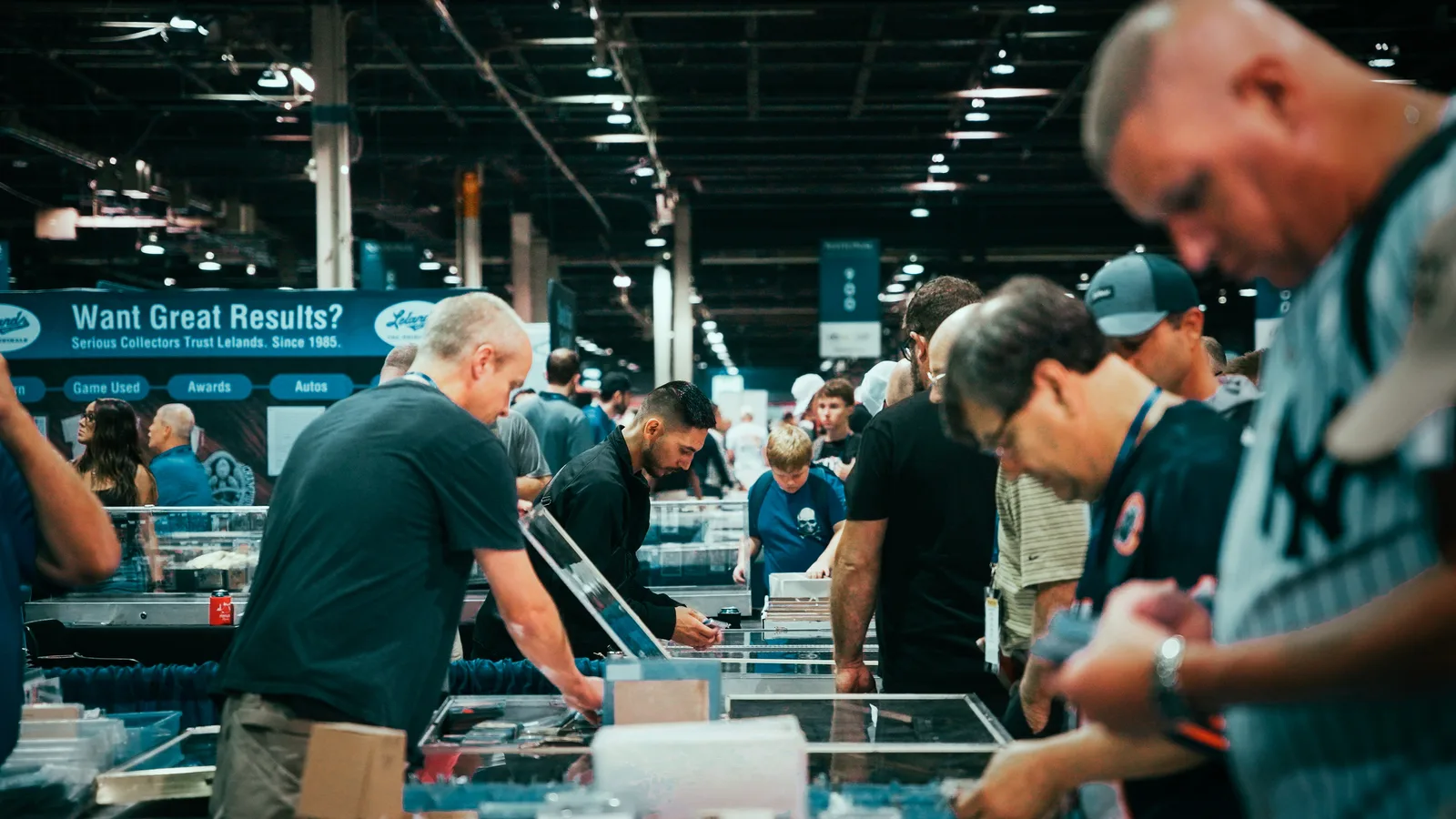
A real shop, a real event floor, live breaks and launches. Physical presence in a hobby that still turns up in person, and the only acquisition channel a competitor cannot clone with software.
How we keep them
Their collection lives here
Scan a card, own a record of it, watch what it is worth over time. A collection is the strongest retention mechanic in any category — nobody rebuilds one somewhere else for fun.
Values they can trust
What a card is worth, with the evidence behind it. The question collectors come back for weekly, and the one most places answer with a number and no working.
A feed that knows them
The drops, the releases and the coverage that match what they actually collect — which is only possible because the identity layer underneath it is real.
Tools, not just content
Scanning, collection management, values, wants and alerts. Content brings a collector in once a week; tools bring them in on a Tuesday night for no particular reason.
A founding partner comes in while the audience is being built, at the price of a platform that is being built — and grows with it.
Running today, and running next
We would rather you know exactly where the line is. The hard part — the graph — is built. Most of what is next is switching things on against it.
Live today
- The identity, pricing and checklist layers above, in production and updating continuously.
- A collector identity spine that ties a person to what they bought, across the shop, the checkout and their account.
- A recommendation engine producing real recommendations against that graph.
- A live newsroom, podcast, video library, creator programme, store and app.
- Directly-sold sponsorship inventory running on our own pages, with per-impression measurement.
Built, not yet switched on
- Joining a media account to a collector record. Built and running quietly today; nothing reads the result yet, and it gets switched on after a human reviews how often it refuses.
- Behavioural signal at scale — what people read, search, watch and chase — flowing into the graph. The rules for how a signal must behave are built and enforced; collecting them broadly is the next step, not something we are already sitting on.
- Email, text and push. Permission is recorded and honoured; sending against it is not switched on yet.
- Audience activation on the large ad platforms, with a permission re-check for every person every time a list is built.
The part that keeps it working
A graph this good only stays good if collectors are happy to be in it. So every collector holds a record of what they have permitted — by purpose and by channel, with the date — that they can read and change themselves. What we infer is labelled as an inference, carries its evidence, and expires. Sharing collector data with anyone outside is a permission of its own, and it is granted to nobody.
And the depth here is in the hobby, not in a dossier on anybody. We know cards, sets, prices and releases exhaustively — that is what makes a placement relevant. A collector gets an experience that feels like the platform knows the hobby, which is the opposite of one that feels like it is watching them.
Founding partners are being chosen now
A small number of categories, taken once. We will walk you through the graph, what it can already target on, what is coming in which order, and where your category fits — with every number sourced and dated.